

← Reconstructing the Sarkaz Language
note
This is a game lore article about the Sarkaz language in Arknights, and is not related in any way to real-world knowledge.
This post has been published on SKLand, NGA and Reddit. Feel free repost this article, but please credit the author Micfong and give the original link.
PRO KOL SARKAZIM!
Over the past two or three years, our understanding of the Sarkaz language has grown a lot clearer as more material has been released. It began with the decipherment of the alphabet (1, 2, 3, 4), and continued through a few studies of my own (1, 2, 3), the posts of @龙门城邦地理 (1, 2), @timnj1's series of articles on other forums (1, 2, 3, 4, 5, 6), Dr. u/tunaOfSpace's work on Reddit (link), and the analyses of many other Doctors. We therefore now have enough information to make reasonable inferences about how Sarkaz is put together, and to reconstruct it as a complete language.
This article covers the etymology, grammar and internal logic of Sarkaz from the ground up, and should deliver a complete specification of the language. The contents are as follows:
- A sample of standardised Sarkaz
- Overview of the attested material
- Earlier decipherment work
- Possible origins of Sarkaz
- Phonology and orthography
- The apostrophe marker and the construct state
- Nouns
- Personal pronouns
- Adjectives, demonstratives and quantifiers
- Verbs
- The negative prefix
sar- - Syntax
- Numerals
- Overview of word formation
- Constructing new words
- Sample new words
- Open questions
- Roots and core vocabulary
- Complete list of coined words
- Misc, acknowledgements and references
Since the Sarkaz script has not been encoded in Unicode, this post writes Sarkaz mainly in its romanised form; the native script appears only in images. The letterforms are based on Dr. @罗醭坦's font, to which I have added glyphs for š/Š, č/Č, ǧ/Ǧ and '. Note also that Sarkaz makes no distinction between upper and lower case. In the romanisation used here we adopt whichever mix reads most easily. Dr. @罗醭坦's Sarkaz font distinguishes case simply by letter size.
For the sake of completeness, the Sarkaz examples given here include invented roots; their sources and rationale are set out in §4 - Possible origins of Sarkaz, §15 - Constructing new words and §19 - Complete list of coined words. As a rule of thumb, within any series of examples the earlier items are attested in game and the later ones are constructed by myself. The Sarkaz reconstructed here is a complete language built along the same lines as the attested material and vocabulary. It should reflect everything that has been made public accurately, but may diverge from future material that Hypergryph has not yet released. Expect errors in this post as I'm not a linguistics expert.
This post marks correct Sarkaz in code blocks and incorrect Sarkaz in *code block with an asterisk.
1 - A sample of standardised Sarkaz
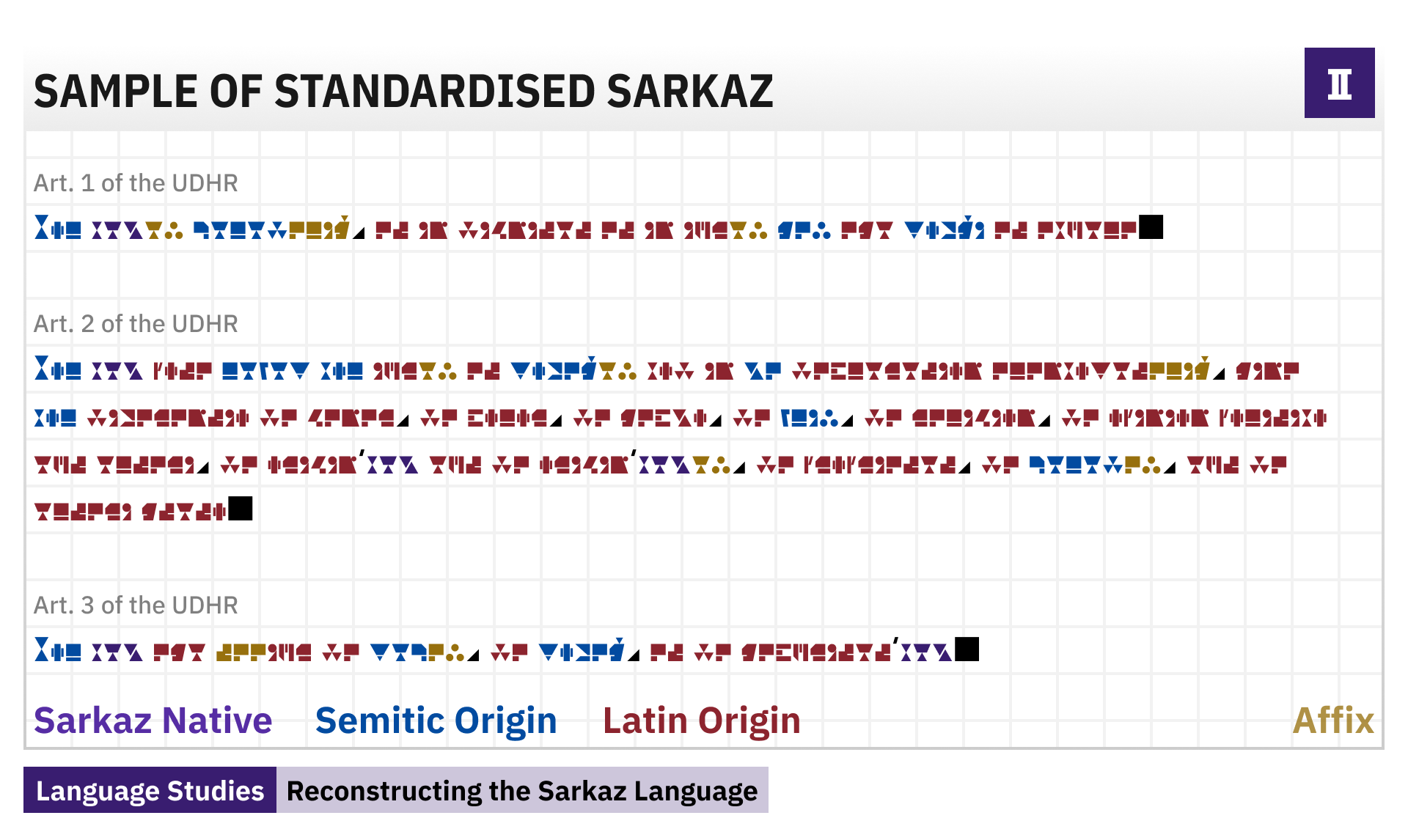
Below are the first three articles of the Universal Declaration of Human Rights translated into Sarkaz.
Article 1. All human beings are born free and equal in dignity and rights. They are endowed with reason and conscience and should act towards one another in a spirit of brotherhood.
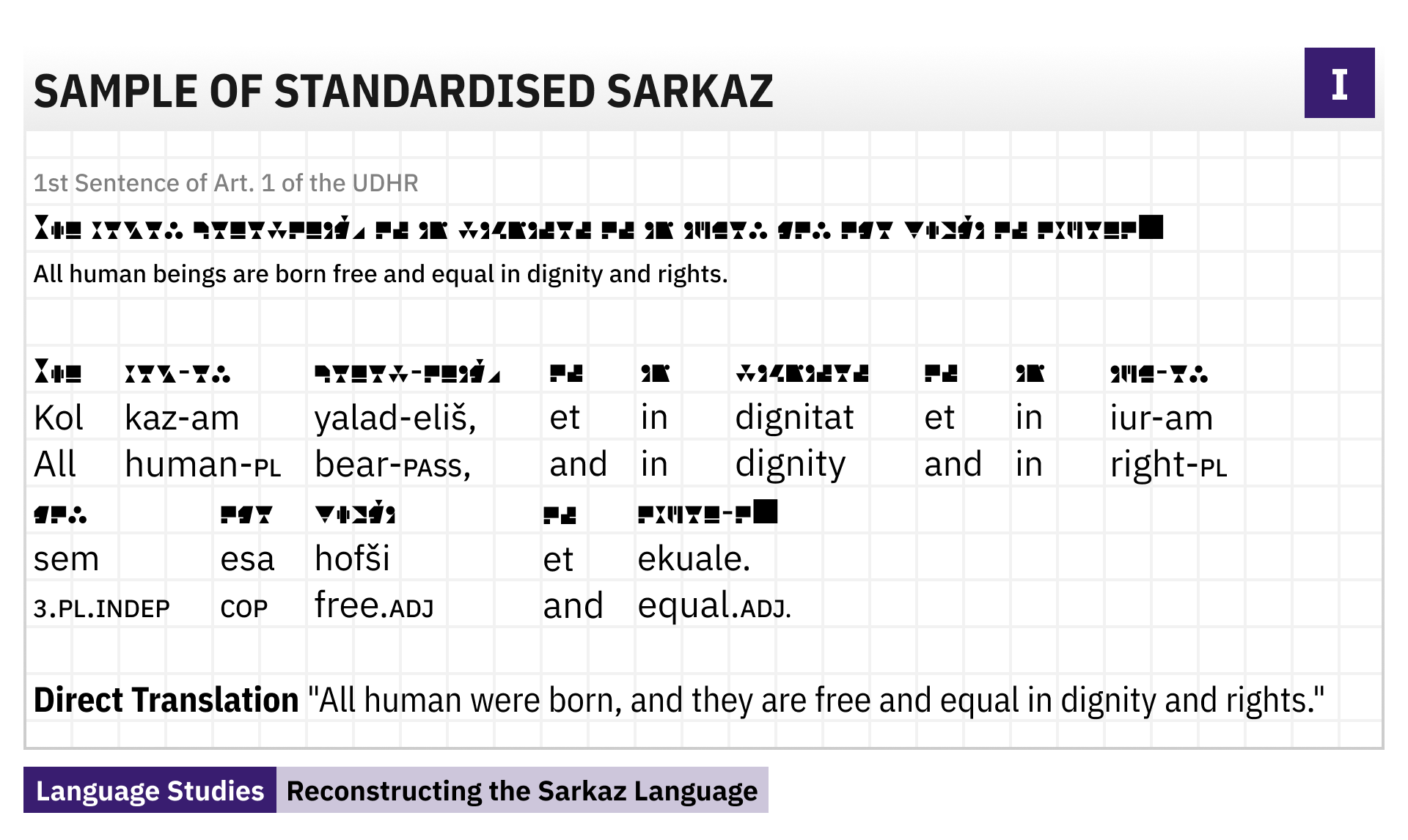
1i: Kol kazam yaladeliš, et in dignitat et in iuram sem esa hofši et ekuale.
Sem esa teebina et teeconscientio, et debe abada inter sem kum leb'ahim.
Article 2 (trimmed). Everyone is entitled to all the rights and freedoms set forth in this Declaration, without distinction of any kind, such as race, colour, sex, language, religion, political or other opinion, national or social origin, property, birth or other status.
2i: Kol kaz pote laqah kol iuram et hofešam kod in ze declaration elenkohateliš, sine kol diferentio de gener, de color, de seczo, de qlim, de religion, de opinion politiko aut alteri, de origin'kaz aut de origin'kazam, de proprietat, de yaladem, aut de alteri stato.
Article 3. Everyone has the right to life, liberty and security of person.
3i: Kol kaz esa teeiur de hayem, de hofeš, et de securitat'kaz.
The morpheme-by-morpheme breakdown of the first sentence of Article 1 is shown below:
The words in these three examples, coloured by etymological origin:
2 - Overview of the attested material
Most of the material we have comes from the EN server's translations of Sarkaz proper nouns in the story, together with the Sarkaz text scattered throughout IS#5 "Sarkaz's Furnaceside Fables". The important ones are listed here for reference.
2.1 - Passages
The following passage appears in the PV for IS#5 "Sarkaz's Furnaceside Fables":
qe nisazzte eld passam.
qe malihate kerda qlim.
manerit ele qlimam. maradit ele agašlehemam.
et in eld urbusil nečateliš. in eld qav'palifanil benulitel.
maraditazam luqimi kerda passam isfaeliš.
qri eld šwiǧemam. šeraqimam koneliš.
qri šeraqimam. kazdelimam koneliš.
passam sarkazo isfit.
Text on the CN January 2025 reward artwork for IS#5:
qunanamel ipsi sar isfa nečata.
2.2 - Proper nouns
From the EN server's story text:
Sarkaz"Sarkaz, 'the rootless'"Teekaz"Teekaz"Kazdel"Kazdel, 'homeland'"Qui'sartuštaj"Qui'sartuštaj, 'undying hope'"Qui'saršinnag"Qui'saršinnag, 'hope that must not be divided'"Duq'arael"Duq'arael, 'the sovereign's red(?)'"Qui'lon"Qui'lon"Gul'dul"Gul'dul"Balor'sača"Balor'sača"Qalid'čoa"Qalid'čoa, 'key'"Duq'kanfališ"Duq'kanfališ"
And our beloved Wiš'adel:
Wiš'adel"Wiš'adel, 'wish of home'"
2.3 - Words and phrases
From the IS#5 PV:
kerdem"rebirth"hal"hatred"agašlehem"thought"vul'fanasm"fantasy"
Track titles from IS#5:
Nar'aejeph Saralteri(No alternatives)Sura Saraǧul'tee(Arise My Friends)Malihirmam Benevolentes
Collectibles and UI text from IS#5:
kerda kaz"new homeland"la'yre agašleho qandecte"catalogue of imagined entities"dwumo resonale"echoes of the age"prophationam nečatum"chapter of prophecies"kal'agašleho upharaelad"collected records of scattered thought"vul'fanas eczbitie"exhibition of fictions"
Reward-screen tabs from IS#5:
agaš"archive / intelligence"hed'hant"headhunt"misionam"missions"iutor"recruit"esqa"squad"tabulo"shop"tesauro"depot"
3 - Earlier decipherment work
The links above have already did quite a lot of work towards deciphering those material, including a (Chinese-)Sarkaz dictionary I compiled earlier. Here we'll briefly summarise the important conclusions from each author:
- @timnj1: after Chapter 13 landed on the EN server, was the first to point out that all the attested material can be cut into monosyllabic CVC/CVV morphemes; that
kaz,quiandsarare three recurring components; thatsar-is a negative morpheme; and thatKazdelis a "home-home" tautological compound. - My own earlier studies: the apostrophe ['] is a Semitic-style construct state, equivalent to English of. I also summarised a number of important Sarkaz etymologies and suffixes. Most native Sarkaz vocabulary comes from Semitic, alongside a large body of Latin loans.
- u/tunaOfSpace: pointed out that
-el+-išand-im+-amare two recurring suffix pairs. - Beyond this, we have also observed that every verb appears to have a Semitic-style consonantal stem, to which a vowel
-aor-e, the perfective-it, or the passive-elišis added.
It is worth noting that noun phrases are not uniformly head-initial. @timnj1 argued from Qui'sartuštaj that Sarkaz is thoroughly head-initial, i.e. that Sarkaz does not say "red apple" but "apple-red". Attributive nominal modifiers do indeed follow the head (the construct state, and the -o relational adjective), but qualitative adjectives uniformly precede it, as in eld passam "old roads", kerda qlim "a new language", sar isfa nečata "writing without end". This makes "qualities before, relations after" an important characteristic of Sarkaz.
4 - Possible origins of Sarkaz
Looking at the attested material, we find that almost all the vocabulary a basic, early civilisation would need comes from Semitic, while Latin supplies predominantly the vocabulary of a more organised society, along with conjunctions and prepositions. We therefore propose that Sarkaz took shape in two stages:
- Before the Sarkaz formed large organised societies, the language was used mainly for speech. Sarkaz at this stage was highly simplified and lacked any standard, and so contained only basic vocabulary of the "world", "home", "hope", "hatred", "sovereign" variety. Most of these words come from Semitic.
- At some point Sarkaz was standardised by some power, and given a register suited to archives, decrees and officialdom. Latin was introduced as the principal source for the written language. From this point Sarkaz began to borrow Latin heavily for the vocabulary a regularised grammar requires, including:
- Function words:
et"and" andin"in" - Institutional vocabulary:
tabulo"shop",tesauro"depot",mision"mission",iutor"recruit",esqa"squad",hed'hant"headhunt",nečata"writing", and so on. - The written register itself: the incantation Rhodes Island operator Logos writes in combat is
scribo imperium, which is a complete Latin sentence.
- Function words:
Further, the Sarkaz word qalid "key" comes from Ancient Greek κλείς, which later passed into Aramaic as qlīdā and Arabic as iqlīd. We therefore place the boundary between these two stages at roughly the Middle Aramaic period, i.e. between the 3rd century BCE and the 3rd century CE.
The reconstructions in this post proceeds on this hypothesis. When coining new words and grammatical structures, we sort vocabulary broadly into two classes:
- Semitic-sourced vocabulary: the basic, the bodily, the emotional, the kinship-related, the natural, the sacred. For example, "blood", "grief", "oath", "root", "stone", "mother", "seven", "mountain".
- Latin-sourced vocabulary: the structural, the institutional, the administrative, the technical, the written. For example, "ledger", "writ", "court", "treasury", "clause", "register", plus function words.
This distinction will guide every section of this post.
5 - Phonology and orthography
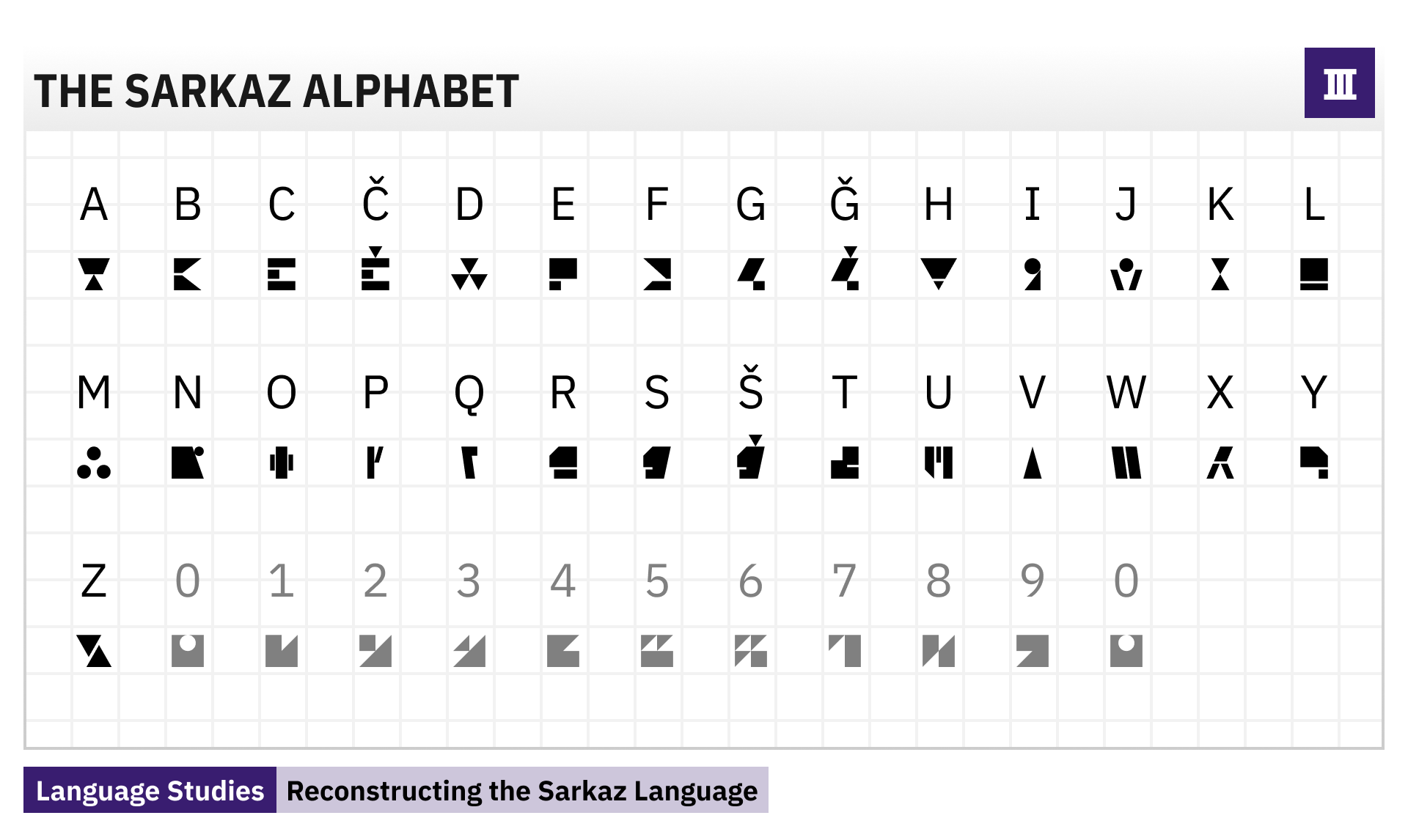
We now make reasonable inferences and extensions to fill in the parts of the language we do not have. Here is the Sarkaz alphabet:
5.1 - Phonemes
The phonemes attested in Sarkaz are:
- Consonants: b, č, d, f, g, ǧ, h, j, k, l, m, n, p, q, r, s, š, t, v, w, z
- Vowels: a, e, i, o, u
Note that Sarkaz has no x, no y (as a vowel), and no independent c, even though the Sarkaz alphabet does contain c, x and y. Judging from the Chinese transliterations of proper nouns, most letters have values close to their English counterparts, with the following exceptions:
| Letter | Value | Confidence |
|---|---|---|
š |
/ʃ/ | High, from the Chinese transliterations |
č |
/tʃ/ | High, from transliteration convention |
ǧ |
/ʒ/ | By transliteration convention; see below |
q |
/q/, uvular | Distinguished from k; see below |
' |
/ʔ/, glottal stop | By transliteration convention, but unconfirmed |
On ǧ**:** it occurs in exactly one word, saraǧul, whose source is Arabic غ (ghayn, /ɣ/). To keep the diacritic system internally consistent (š /ʃ/ — ǧ /ʒ/ — č /tʃ/ form a tidy set of postalveolars), we take it to be /ʒ/. Arabic ghayn to /ʒ/ is perhaps no more than an ordinary sound change. This way no spelling needs special treatment.
On q**:** it occurs only in words of Semitic origin, such as qui, qe, qlim, qalid. To keep it distinct from k, we rule that Latin-sourced vocabulary never uses q, and that Latin qu- /kw/ always enters Sarkaz as k-: quod → kod, quomodo → komo, quia → kia, quaeso → keso, and so on. The presence of q alone therefore tells you whether a word is of Semitic origin.
5.2 - Stress
Sarkaz stress cannot currently be determined, but given the language's Semitic character, stress should normally fall within the last two syllables. We provisionally place it on the penultimate syllable, except that compounds made of two monosyllabic roots take stress on the final syllable: kaz-DEL, sar-KAZ.
5.3 - Syllable structure
Sarkaz syllable structure comes in two types:
- Core roots are all monosyllabic CVC/CVV:
sar,kaz,del,qui,tee,duq,wiš,hal,eld,qav,gul,lon,nag,taj,tušand so on. These roots carry all compound word formation. - The bulk of the vocabulary is polysyllabic, and permits consonant clusters the first type forbids:
malihate,agašlehem,nisazzte,vul'fanasm,malihirm,urbusil. The attested initial clusters areql-andšw-; the final clusters are-sm,-rm,-nt,-ld,-zzt.
Geminate consonants also exist (pass, nisazzte), though where Semitic uses gemination for the intensive and causative stems, Sarkaz appears to make no use of it.
5.4 - Orthography of Latin loans
From the attested Latin loans we can generalise the following set of rules for borrowing Latin vocabulary into Sarkaz.
Latin loans should conform to the following:
| Latin | Sarkaz | Example |
|---|---|---|
| c | c |
lice < licere, qandecte, eczbitie |
| ch | k |
makino < machina, skolo, karto |
| qu- | k |
kod, komo, kia |
| x | cz |
eczbitie < exhibitio, eczemplar, piczel |
| th | t |
tesauro < thesaurus |
| ph | f |
fisiko < physica |
| y | i |
fisiko < physica |
Note that k in a Latin-sourced word must come from qu- or ch-, never from c.
Exception: nečata < necatum writes Latin c as č. Given that Sarkaz already has the letter c, this may be some special rule in the official setting, but it is hard to generalise from at present.
Declensions should be handled as follows:
- First and second declension nouns → stem +
-o:tabulo< tabula,tesauro< thesaurus - Third declension -tio/-sio →
-ion:mision< missio,prophation,translation - Third declension consonant stems → take the oblique stem:
ordin< ordo/ordin-,civitat,iur< ius/iur- - Third declension adjectives in -alis →
-ale:resonale,oficiale,ekuale - Verbs → stem + thematic vowel
-a/-e:lice,pote,debe,vole,navige,lege
6 - The apostrophe marker and the construct state
The apostrophe marker ['] is the most distinctive feature of Sarkaz, and its source is the Semitic construct state. In Semitic, the construct state expresses a dependency relation between nouns, equivalent to English of. Here we discuss how the apostrophe is used and extend it sensibly.
6.1 - Marking the construct state
In the construct state the head comes first and the modifier follows, marking the dependency. X'Y means "Y's X". For example:
hal'saraǧul"hatred between friends"wiš'adel"wish of home"passam'sarkaz"the roads of the Sarkaz"qalid'čoa"key of opening"duq'arael"the sovereign's red"qav'idan"boundary of time (time zone)"saraǧul'tee"my friend"leb'ahim"heart of brothers"
Possession also uses the apostrophe marker; see §8 - Personal pronouns.
Further, when the first noun ends in a sibilant (s, š, z) and the second begins with a stop (b, d, g, k, p, q, t), an a is inserted after the apostrophe. Thus wiš + del → wiš'adel, not *wiš'del.
This rule accounts for the otherwise unexplained a- in Wiš'adel. None of the other attested apostrophe forms previously triggered it, including hal'saraǧul (l+s), passam'sarkaz (m+s), qav'palifanil (v+p), gul'dul (l+d), qalid'čoa (d+č), balor'sača (r+s), duq'arael (q+vowel), qui'sar- (vowel+s). This is probably the reason it was not noticed before.
6.2 - Separating loanwords
Note that hed'hant < headhunt does not fit the "Y's X" structure. We therefore judge the apostrophe to be dual-purpose: its second function is an innovation of the standardisation period discussed below. When standardisation began importing polysyllabic loanwords in bulk, the mark was pressed into service as a morpheme separator in loanwords.
To tell the two uses apart, we rule that if both sides of the apostrophe are words that can stand alone in Sarkaz, it is a dependency structure; if either side cannot stand alone, the apostrophe is merely separating a loanword. Both halves of hal'saraǧul are independent words, so it is a dependency structure. Neither half of hed'hant is, so it is a loanword.
7 - Nouns
Sarkaz has several fairly clear nominal morphological features.
7.1 - The plural suffix -am
To pluralise a Sarkaz noun, nouns ending in a consonant simply take -am.
| Singular | Plural |
|---|---|
kaz person |
kazam |
qlim language |
qlimam |
mision mission |
misionam |
pass road |
passam |
agašlehem thought |
agašlehemam |
Nouns ending in -a/-e replace that vowel with -am. Nouns ending in another vowel, which cannot be replaced, take a linking glide matched to that vowel on phonological grounds:
| Ending | Glide | Example |
|---|---|---|
-i |
-y- |
luqimi → luqimiyam |
-o |
-w- |
proiecto → proiectowam |
-u |
-w- |
tribu → tribuwam |
7.2 - The collective suffix -im
Note that kazdelimam can be cut into kazdel + -im + -am, where -im derives from the Hebrew masculine plural ־ִים. On semantic grounds we take -im to attach to proper nouns to mean "the people of somewhere", with the following -am as the plural suffix.
| Noun | Collective |
|---|---|
sarkaz Sarkaz |
sarkazim the Sarkaz peoples |
kazdel Kazdel |
kazdelim the peoples of Kazdel |
del home |
delim a household |
ah brother |
ahim brothers |
7.3 - The gentilic suffix -o
The attested material has sarkaz → sarkazo ("Sarkaz-", "the Sarkaz language"), where -o forms a postposed gentilic adjective interchangeable with the apostrophe construct state: passam sarkazo = passam'sarkaz. To avoid confusion with the -o of Latin loans, we rule that the gentilic -o applies only to proper nouns; elsewhere the apostrophe marker is used.
| Noun | Gentilic adjective |
|---|---|
sarkaz Sarkaz |
sarkazo Sarkaz- |
kazdel Kazdel |
kazdelo Kazdelian |
teekaz Teekaz |
teekazo Teekaz- |
7.4 - The nominalising suffix -m
It is hard to miss that many abstract nouns end in -m, so we take -m to be a nominalising suffix. It turns adjectives, verbs, nouns and so on into abstract nouns. A vowel -e- may be inserted where the stem ends in a vowel or where phonology otherwise requires it.
| Source | Noun |
|---|---|
vul'fanas fictional |
vul'fanasm fantasy |
kerda new |
kerdem rebirth |
eld old |
eldem antiquity |
isfa to end |
isfem ending |
duq to shatter |
duqem destruction |
haza to see |
hazem a viewing |
tana to give |
tanem gift, donation |
7.5 - The locative suffix -il
A Sarkaz word can take -il after the stem to form a noun of place. The suffix appears to come from Latin īle, "place for something". In Sarkaz, -il can denote buildings, rooms, sites and the like.
| Source | Place |
|---|---|
agaš archive |
agašil archive building |
del home |
delil dwelling |
hal hatred |
halil place of hatred |
nečata writing |
nečatil scriptorium |
lege to read |
legil library |
abada to labour |
abadil workshop |
selem image |
selemil gallery |
daem flight |
daemil airport |
qav boundary |
qavil checkpoint |
Note that not every word of place is derived: kaz and del are basic nouns, and tabulo and tesauro are existing place words with no suffix. -il is therefore a derivational suffix only, not a marker on all words of place.
7.6 - Other Notes
Sarkaz nouns have no case, no gender, no articles and no dual, and the head itself does not inflect. Number, collectivity, relation and so on are all expressed by suffixes or the apostrophe marker.
8 - Personal pronouns
The only personal pronouns in the attested material are qe "I" and tee "my", so we need to create a full set to complete the pronoun system.
8.1 - The pronoun table
| Independent (subject) | Dependent (possessive) |
|---|---|
| 1sg (I) | qe |
| 2sg (you) | ne |
| 3sg (he/she/it) | se |
| 1pl (we) | qem |
| 2pl (you) | nem |
| 3pl (they) | sem |
The dependent series can only be used inside an apostrophe construct state: saraǧul'tee "my friend", saraǧul'ne "your friend", saraǧul'se "his friend", del'qem "our home", passam'sem "their roads", and so on.
Apart from the first person singular, the dependent and independent forms are identical, because tee is the only pronoun in the Sarkaz system with a special use of its own (see below).
8.2 - Preposed tee
tee can occasionally be preposed: tee saraǧul "my friend", tee del "my home".
Beyond that, tee- is an older prefix meaning adjectivally "having, endowed with". It forms a matched positive/negative pair with sar-:
sarkaz"one deprived of a homeland"teekaz"one granted a homeland"teequi"one who holds hope → idealist"sartelo"offline"teetelo"online"teetoda"grateful"teeabadem"having work in hand → busy"teebina"endowed with reason"
In general, the prefix tee- means "having, endowed with", while the standalone dependent tee means "my". Thus teequi "one who holds hope" versus tee qui "my hope".
Note that no other pronoun may be preposed: *ne saraǧul, *se del and *qem passam are all ungrammatical Sarkaz.
9 - Adjectives, demonstratives and quantifiers
Adjectives, demonstratives and quantifiers all precede the noun:
eld passam"old roads"kerda qlim"a new language"ze passam"this road"ele qlimam"these words"rab kazam"many people"šalaš passam"three roads"kol kazam"all people"
9.1 - Demonstratives and quantifiers
The common demonstratives are:
ze"this (proximal)"ele"these"hu"that (distal)"rab"many, great, much"kol"all, every, each"
Note in particular that rab covers both "many" and "master", consistent with Proto-Semitic *rabb-.
9.2 - Comparatives and superlatives
Sarkaz has no grammatical marking for the comparative or superlative. Therefore:
rabcan mean "many" or "more"tobcan mean "good", "better" or "best"
The precise sense must be judged from context.
9.3 - Nouns used as adjectives
An ordinary noun can directly modify another noun, preceding it just as an adjective does:
prophationam nečatum"chapter of prophecies"vul'fanas eczbitie"exhibition of fictions"dwumo resonale"echoes of the age"zahab division"gold division"papiro sefer"paper book"yad nečatem"handwriting"
Proper nouns, however, must take -o and follow, or else use the apostrophe construct state:
passam sarkazo"the roads of the Sarkaz"passam'sarkaz"the roads of the Sarkaz"
10 - Verbs
Sarkaz verbs do not vary for person, number or tense; they vary only for aspect and voice. Time is expressed lexically and by context, and an unmarked verb reads as present or future depending on context.
10.1 - Stems
Every Sarkaz verb has a consonantal stem; the citation form adds a final vowel -a or -e to that stem. All suffixes attach to the stem, not to the citation form.
| Citation form | Stem |
|---|---|
nečata to write |
nečat- |
malihate to speak |
malihat- |
kone to establish |
kon- |
sura to rise |
sur- |
marada to rebel |
marad- |
nisazzte to forsake |
nisazzt- |
haza to see |
haz- |
isfa to end |
isf- |
šapal to bring low |
šapal- (no thematic vowel) |
halak to walk |
halak- (no thematic vowel) |
laqah to receive |
laqah- (no thematic vowel) |
10.2 - Inflected forms
Sarkaz verbs have three main inflected forms: perfective, passive and negative, marked by just three affixes: -it, -eliš and sar-. The imperative is identical to the plain form and the prohibitive to the negative, with the subject simply omitted. The rules are as follows:
| Form | Rule | Example |
|---|---|---|
| Plain | citation form | malihate to speak |
| Perfective | stem + -it |
nečatit has written |
| Passive | stem + -eliš |
nečateliš is written |
| Negative | prefix sar- |
sarmalihate not to speak |
| Imperative | citation form, subject omitted | čoa! open! |
| Prohibitive | sar- + citation form, subject omitted |
sarmalihate! do not speak! |
Some common verbs (for the full lexicon see §19 - Complete list of coined words):
| Plain | Perfective | Passive | Negative |
|---|---|---|---|
nečata to write |
nečatit |
nečateliš |
sarnečata |
malihate to speak |
malihatit |
malihateliš |
sarmalihate |
kone to establish |
konit |
koneliš |
sarkone |
sura to rise |
surit |
sureliš |
sarsura |
čoa to open |
čoit |
čoeliš |
sarčoa |
marada to rebel |
maradit |
maradeliš |
sarmarada |
nisazzte to forsake |
nisazztit |
nisazzteliš |
sarnisazzte |
šapal to bring low |
šapalit |
šapaleliš |
saršapal |
haza to see |
hazit |
hazeliš |
sarhaza |
tana to give |
tanit |
taneliš |
sartana |
esa to be |
esit |
—— | saresa |
isfa to end |
isfit |
isfaeliš |
sarisfa |
isfa is the only irregular verb in Sarkaz. Its passive keeps the thematic vowel, giving isfaeliš where the regular form would be *isfeliš. Its perfective isfit is still regular.
10.3 - The participial-noun suffix -el
-el attaches to a verb stem to form a participle or participial noun: benulitel, qunanamel, konel "builder", visitel "visitor", masel "finder", navigel "browser".
-el differs from the Latin-derived -tor in that -el is used for agents generally, while -tor is used for offices. Thus navigel "browser" and servel "server" are things in the act of doing, while operator "operator" is a post.
10.4 - The copula esa
On the evidence of the attested material, every Sarkaz sentence has a verb, so we need to introduce a copula. We choose esa "to be", from Latin (see §4 - Possible origins of Sarkaz). Its perfective is esit, its negative saresa; it has no passive. For example:
qe esa sarkaz."I am a Sarkaz."kazdel saresa del'tee."Kazdel is not my home."hal'saraǧul esa eld."The hatred between friends is ancient."se esit kerda."It was once new."
10.5 - Modal verbs
We likewise need modal verbs to express possibility, ability and obligation. We borrow the following from Latin:
pote"can, may"debe"ought, must"vole"want, intend"lice"be permitted"
These give Sarkaz a modal system, for example:
qe pote malihate sarkazo."I can speak Sarkaz."ne debe nisazzte eld passam."You must forsake the old roads."qe sarpote malihate sarkazo."I cannot speak Sarkaz."
Note that the negative prefix sar- (see §11 - The negative prefix sar-) attaches to the modal verb, not to the main verb.
Modals give Sarkaz a precise way to say "cannot" or "will not", but since sar- already covers both "not" and "cannot", "I cannot speak Sarkaz" can equally be written qe sarmalihate sarkazo; the modals serve only as reinforcement where ambiguity might arise.
10.6 - The verbalising suffix -hate
A noun can take the suffix -hate to form a verb meaning "to cause, to bring about".
| Noun | Verb |
|---|---|
mali word |
malihate to speak |
wiš wish |
wišhate to wish |
hal hatred |
halhate to hate |
kerdem rebirth |
kerdemhate to renew, refresh |
hazem viewing |
hazemhate to display |
tob good |
tobhate to make better |
šem name |
šemhate to call, to name |
neder oath |
nederhate to promise |
sudar veil |
sudarhate to veil, to hide |
agašlehem thought |
agašlehemhate to consider |
efes nothing |
efeshate to empty |
qui hope |
quihate to await, to expect |
halakem march |
halakemhate to move |
11 - The negative prefix sar-
sar- can negate any part of speech, as shown below:
| Part of speech | Source | Negated form |
|---|---|---|
| Noun | kaz home |
sarkaz one without a home (Sarkaz) |
| Verb | malihate to speak |
sarmalihate not to speak |
| Adjective | tuštaj perishing |
sartuštaj undying |
| Attributive verb | isfa to end |
sar isfa without end |
| Passive | masa to find |
sarmaseliš not found |
sar- is written together with the word when it negates a finite verb, a noun or an adjective (sarmalihate, sarkaz, saresa), but stands as a separate word when it negates a verb used attributively (sar isfa nečata "writing without end").
sar- is remarkably common in Sarkaz, which may have something to do with their long history of exile and homelessness.
12 - Syntax
12.1 - Basic sentence structure
Basic Sarkaz sentence structure is SVO:
qe malihate kerda qlim."I speak a new language."qe nisazzte eld passam."I forsake the old roads."tee saraǧul sura."My friend rises."hal'saraǧul isfit."The hatred between friends has ended."passam sarkazo isfit."The roads of the Sarkaz have ended."
12.2 - Adverbials
Prepositional phrases and adverbs always sit between the subject and the verb, never after the object.
in eld urbusil nečateliš."It is written in the ancient archives."qe in kazdel esa."I am in Kazdel."se kum saraǧul'tee malihate"He speaks with my friend."
12.3 - Presentational sentences
When introducing something new (a presentational sentence, like English there was, there arose), the verb moves to the front:
manerit ele qlimam."These words have endured."maradit rab kazam."Many people rebelled."
12.4 - Common prepositions and conjunctions
Sarkaz prepositions and conjunctions all come from Latin.
Common prepositions:
ininadtodefrom, aboutkumwith, by means ofsinewithoutperthrough, by way ofproforpostafterantebeforesubundersuperaboveinterbetweenqrithrough, by means of
Common conjunctions:
etandautorsedbutkiabecausesiifnisiunlessdumwhileergothereforetamenhowever
12.5 - Interrogatives
A Sarkaz question needs only an interrogative word at the head of the sentence. The interrogatives are:
numwhetherkidwhatkiswhokandowhenkothow manykurwhykomohowubiwhere
For example:
num ne malihate sarkazo?"Do you speak Sarkaz?"num se isfit?"Has it ended?"kid ne nisazzte?"What did you forsake?"ubi nečateliš?"Where is it written?"
ubi can also serve as a headless relative:
aut ubi qe pote abada emeti diferentio"or wherever I can make a real difference"
12.6 - Relative clauses
Sarkaz kod serves both as a relative pronoun and as a complementiser; relative clauses follow the head:
passam kod qe nisazzte"the road that I forsook"saraǧul kod sura"the friend who rose"qe malihate kod kazdel saresa del'tee."I say that Kazdel is not my home."
ut introduces purpose clauses:
qe nečata ut se malihateliš."I write, so that it may be spoken."
12.7 - Full noun-phrase order
From the analysis above, the full order of the Sarkaz noun phrase is:
[demonstrative/quantifier] [adjective] HEAD [-o relational adjective] ['dependent] [kod relative clause]
For example: ele eld passam sarkazo "these old roads of the Sarkaz".
13 - Numerals
Since numbers are never mentioned anywhere in the attested material, we must build the numerals from scratch. Following the principles set out previously, we build the Sarkaz numerals from Proto-Semitic.
13.1 - The numerals
| Value | Proto-Semitic | Hebrew | Sarkaz |
|---|---|---|---|
| 0 | (none) | אֶפֶס ʾep̄es | efes |
| 1 | *ʔaḥad- | אֶחָד ʾeḥāḏ | had |
| 2 | *ṯin- | שְׁנֵי šənê | šin |
| 3 | *ṯalāṯ- | שָׁלֹשׁ šālōš | šalaš |
| 4 | *ʔarbaʕ- | אַרְבַּע ʾarbaʿ | arba |
| 5 | *ḫamš- | חָמֵשׁ ḥāmēš | hameš |
| 6 | *šidṯ- | שֵׁשׁ šēš | šeš |
| 7 | *šabʕ- | שֶׁבַע šeḇaʿ | šab |
| 8 | *ṯamāniy- | שְׁמוֹנֶה šəmônɛ̂ | šamane |
| 9 | *tišʕ- | תֵּשַׁע tēšaʿ | teša |
| 10 | *ʕaśar- | עֶשֶׂר ʿéśer | asar |
| 100 | *miʔat- | מֵאָה mēʾâ | mea |
| 1000 | *ʔalp- | אֶלֶף ʾélep̄ | alef |
Proto-Semitic has no word for "zero", so we substitute Hebrew אֶפֶס ʾep̄es (H657, from ʾāp̄ēs "to cease"), glossed in the lexicons as "ceasing, hence: end, extremity… expressing non-existence" (Isa. 34:12 "brought to nothing"; Zeph. 2:15 "I am, and there is none besides me").
13.2 - Using the numerals
Numerals in Sarkaz are quantifiers, and so precede the noun:
šalaš passam"three roads"asar kazam"ten people"
Sarkaz builds compound numerals by simple addition (much as Chinese does), linking the parts with hyphens:
asar-had11šin-asar20šin-asar-šalaš23šalaš-mea300
Ordinals take the suffix -i and follow the noun:
passam hadithe first roadnečatum šalašithe third chapterkerdem isfithe last update
14 - Overview of word formation
| Morpheme | Type | Function |
|---|---|---|
' |
clitic /ʔ/ | dependency structure; loanword separator |
sar- |
prefix | negation, privation |
tee- |
prefix | having, endowed with |
-am |
suffix | plural |
-im |
suffix | collective, ethnonym |
-m / -em |
suffix | nominaliser |
-il |
suffix | noun of place |
-o |
suffix | relational adjective; language name |
-i |
suffix | ordinal |
-el |
suffix | participle, agent noun |
-tor |
suffix | agent noun denoting an office |
-it |
suffix | perfective |
-eliš |
suffix | passive |
-hate |
suffix | verbaliser, "to bring about" |
a- |
epenthesis | linking vowel between sibilant and stop |
-y- / -w- |
epenthesis | linking glide before the plural |
Sarkaz forms compounds in three main ways:
- Apostrophe-marked dependency:
hal'saraǧul"hatred between friends",passam'sarkaz"the roads of the Sarkaz" - Compound numerals:
šin-asar-šalaš(23) - Synonym compounding:
kazdel"Kazdel, 'homeland'". This works much like English synonym compounds such as "pathway" or "courtyard", where both halves carry roughly the same sense. That said, the only attested example of synonym compounding in Sarkaz iskazdelitself, so it should be used sparingly.
15 - Constructing new words
15.1 - Procedure
When coining a new word, follow this procedure:
- Check whether the concept can be expressed by combining words already in the lexicon.
- If not, choose an appropriate source language following the principles in §4 - Possible origins of Sarkaz.
- If using a Semitic source:
- Establish the most general Semitic form, normally Proto-Semitic.
- Choose a reference language in the order Hebrew > Aramaic > Arabic. The target period is roughly the 3rd century BCE, normally Biblical Hebrew and Biblical/Imperial Aramaic.
- Transcribe the Semitic source into Sarkaz using §15.2 - Semitic sound correspondences.
- If using a Latin source:
- Use Classical Latin as the reference, consulting Medieval Latin where necessary.
- Transcribe the Latin source into Sarkaz using §5.4 - Orthography of Latin loans.
- Check the result for spelling collisions.
15.2 - Semitic sound correspondences
| Semitic | Sarkaz | Example |
|---|---|---|
| ʔ (aleph), ʕ (ayin) | dropped word-initially; written ' at a morpheme boundary |
*ʔaḥad- → had; *ʕaśar- → asar |
| ḥ, ḫ | h |
*ḫamš- → hameš; ḥāzâ → haza |
| ṯ | š |
*ṯalāṯ- → šalaš |
| ś (Hebrew sin, /ɬ/ → /s/) | s |
*ʕaśar- → asar; śārāp̄ → saraf; śāḥaq → sahaq |
| š (Hebrew shin) | š |
*šabʕ- → šab |
| ġ (Arabic ghayn) | ǧ /ʒ/ |
ghūl → -ǧul |
| q | kept as q |
qôl → qol; qeraḥ → qerah |
| k | kept as k |
kōl → kol |
| p̄ | f |
śārāp̄ → saraf; kesep̄ → kesef; yāsap̄ → yasaf |
| feminine endings *-at, *-ā | -a |
millâ → mali-; ḥāzâ → haza |
The following supplementary rules apply where needed:
- Final ʕ is dropped. The table above gives word-initial loss and
'at a morpheme boundary, but a root-final consonant is not a morpheme boundary, so it drops:šama< šāmaʿ,reg< regaʿ. - Root-medial ʔ is dropped. As above,
'marks morpheme boundaries, and a medial consonant is inside the morpheme, not between morphemes:daa< dāʾâ,masa< māṣāʾ,šala< šāʾal. - Emphatic ṣ →
s. Sarkaz has no emphatics, so it merges intos:masa< māṣāʾ,salah< ṣālaḥ,selem< ṣelem. - Geminates within a root are simplified:
šat< *šatt-,ata< ʿattâ,leb< *libb-,idan< ʿiddān,pina< pinnâ. - The diphthong *aw →
o:yom< *yawm-.
16 - Sample new words
| English | Sarkaz | Source type | Source |
|---|---|---|---|
| day; daylight | yom |
Semitic | Proto-Semitic *yawm- |
| night | lel |
Semitic | Aramaic construct lêl- |
| year | šat |
Semitic | Proto-Semitic *šan-t- > *šatt- |
| hour | hora |
Latin | hōra |
| time, period | idan |
Semitic | Aramaic ʿiddān |
| now | ata |
Semitic | Hebrew ʿattâ |
| moment | reg |
Semitic | Hebrew regaʿ |
| future | futuro |
Latin | futūr- |
| to see, to behold | haza |
Semitic | Hebrew/Aramaic ḥăzâ |
| to hear | šama |
Semitic | Proto-Semitic *šamaʕ- |
| voice | qol |
Semitic | Hebrew qôl |
| to read | lege |
Latin | legere |
| to find | masa |
Semitic | Hebrew māṣāʾ |
| name | šem |
Semitic | Proto-Semitic *šim- |
| to give | tana |
Semitic | Hebrew nātan, imperative tēn |
| to take, to receive | laqah |
Semitic | Hebrew lāqaḥ |
| to play | sahaq |
Semitic | Hebrew śāḥaq |
| to labour, to make | abada |
Semitic | Hebrew/Aramaic ʿăbad |
| to fly | daa |
Semitic | Hebrew dāʾâ |
| to sail | navige |
Latin | navigāre |
| water | may |
Semitic | Proto-Semitic *may- |
| ice | qerah |
Semitic | Hebrew qeraḥ |
| hand | yad |
Semitic | Proto-Semitic *yad- |
| all, every | kol |
Semitic | Hebrew kōl |
| truth | emet |
Semitic | Hebrew ʾĕmet |
| heart; will | leb |
Semitic | Proto-Semitic *libb- |
17 - Open questions
- Punctuation is unsettled. For now we recommend only a conservative set: the full stop (
.), comma (,), question mark (?), exclamation mark (!), colon (:), quotation marks (") and parentheses (()). - We provisionally take Sarkaz to lack gender, case, tense, agreement, comparatives, a causative stem, reflexive and reciprocal pronouns, and any voice other than the passive.
(To be continuously revised.)
18 - Roots and core vocabulary
18.1 - Core roots
kaz homeland; kin · del home · sar- gone, lacking · tee- having, endowed with · qui hope · qav cord, boundary, measure · hal hatred · eld old · kerd- new · duq to shatter, to crush · wiš wish, longing · mali word · -hir light of revelation · -hate to bring about · alma world; age · arael sovereign; champion · qlim language · šanae sky · sura to rise · isfa to end · čoa to open, to unlock · kal scattered, lost · lon companion, peer · sudar veil, shroud · dwumo age, era · agaš archive, intelligence, record · -leho / -lehem thought, mind · qalid key
18.2 - Time
yom day · lel night · šat year · hodeš month · hora hour · idan period · ata now · reg moment · futuro future · kalendo date · dwumo era · qav'idan time zone
18.3 - Perception and cognition
haza to see · hazem a viewing · hazemhate to display · šama to hear · qol voice · malihir spirit-sight · lege to read · nečata to write · masa to find · šem name · bina reason · agašlehem thought · agašlehemhate to consider · sefer book · safar to count, to recount · šala to ask · ana to answer · hida riddle · emet truth · emeti true · miqre chance
18.4 - Actions
tana to give · laqah to take, to receive · sahaq to play · abada to do, to labour · daa to fly · navige to sail · halak to walk · sura to rise · šapal to bring low · kone to establish · marada to rebel · šara to endure · palat to escape · sahar to trade · bahar to choose · yasaf to add · nasa to try · salah to succeed · yašen to sleep · yalad to be born · haya to live · qava to draw taut · čoa to open · klaude to close
18.5 - Substance and daily life
may water · qerah ice · hol sand · yad hand · esba finger · leb heart · ah brother · kesef silver, money · zahab gold · sefer book · selem image · rešet net · migdal tower · misgab fortress · aron chest · maqom place · pina corner · neder oath · toda thanks · tob good · hofeš freedom · kol all · rab many
18.6 - High-frequency Latin loans
esa to be · pote can · debe ought · vole to want · lice may · et and · aut or · sed but · si if · kia because · nisi unless · dum while · ergo therefore · tamen however · in in · ad to · de about · kum with · sine without · per through · pro for · post after · ante before · sub under · super above · inter between · kod that (relative) · ut so that · num whether · kid what · kis who · kando when · kot how many · kur why · komo how · ubi where · etiam also · iam already · plerumke usually · simplice simply · keso please
19 - Complete list of coined words
See the Sarkaz-Chinese Dictionary for a complete list of all words attested or coined in Sarkaz, with their sources and etymologies.
20 - Misc, acknowledgements and references
Perhaps one day I will vibe-code build a Sarkaz dictionary site so that all this is easier to look up. Edit: the Sarkaz-Chinese Online Dictionary is now live!
Getting back into writing about Arknights after nearly two years away feels a little unreal. The world changes fast; I hope every Doctor out there is doing well.
The Chinese version of this article was written entirely by a human, and LLM is used to assist translation; otherwise LLMs were used only for looking things up and for proofreading, and I have done my best to verify everything in it. My time being limited, there are certainly oversights, and I would welcome corrections from any Doctor. This piece took well over a hundred hours to write, and is the most complicated research article I have produced to date.
What set all this off was, in fact, wanting to add a Sarkaz translation to my personal site, and somewhere along the way it turned into a complete constructed-language specification. On the site, Sarkaz is implemented by shifting every character used by 0xE000, mapping the Sarkaz alphabet into the Unicode Private Use Area, and embedding a modified version of the font mentioned above. There is also a romanised version of the Sarkaz site for anyone who wants to read it more easily. If you would rather not open it, here is the full text of my Sarkaz bio:
Qe esa Zi'Šuan Čang. Qe in Universitat'Cantabrigia matematiko disce, et kum asar šatam'hazemam esa konel, de sistemowam ad kol strato telo ad UI designo. Qe plerumke in Rust et Python abada, de nukleowam'sistemo ad telo aplicationam. Kazam etiam šemhate qe Mika'el aut Mikfong.

Wiš'tee esa: kum agaš'scientio et makinam tana ad kol sarkazim, et kum leb'tee tobhate alma. Qe vole intersectionam'kampowam: matematiko, fisiko, biologio, computation, aut ubi qe pote abada emeti diferentio. Num rab kerda? Pote esa. Qe in rab idanam haza ipsi: teequi kod haza qavqui.

Qe in sarabadem lege scientio vul'fanas et sahaq computel sahaqemam (plerumke ne pote masa had de sem kod in ze sito sudarhateliš). Kerda studio'tee esa Star'Set. Ata del'tee in UTC+1 esa.
I hope this article helps people go on making more Sarkaz and Kazdel content! Looking forward to the day Kazdel's literacy schools open on Earth.
After all this waiting Hypergryph still hasn't brought Scout back 😡 come back, o soul, come back (surely this rite works)
Acknowledgements
Special thanks to the Arknights community for its discussion and sharing on Sarkaz linguistics, and in particular to:
- NGA user @timnj1
- Reddit user u/tunaOfSpace
- @龙门城邦地理 on Weibo
- Skland user @罗醭坦
Skland, NGA and Reddit user @myself
Without their discussion and sharing, reconstructing Sarkaz would have been hopeless.
References
- The following posts by the users above:
- https://bbs.nga.cn/read.php?tid=33915513
- https://bbs.nga.cn/read.php?tid=32404770
- https://weibo.com/7200626168/NqPITBxZq
- https://www.skland.com/article?id=1482942
- https://www.skland.com/article?id=2052111
- https://www.skland.com/article?id=2220540
- https://www.skland.com/article?id=2672868
- https://weibo.com/7200626168/OnvaXtRCi
- https://weibo.com/7200626168/OCUlUsnLG
- https://ngabbs.com/read.php?tid=39921984
- https://ngabbs.com/read.php?tid=40025297
- https://ngabbs.com/read.php?tid=40071023
- https://ngabbs.com/read.php?tid=40934760
- https://ngabbs.com/read.php?tid=41001126
- https://ngabbs.com/read.php?tid=44053986
- https://www.reddit.com/r/arknights/comments/1fdvgsw/kazdelian_language_studies_a_dynamic_lexicon_of/
- Wiktionary contributors. (2026). [Various entries]. In Wiktionary, the free dictionary from wiktionary.org.
- Brown, F., Driver, S. R., & Briggs, C. A. (1906). The Brown-Driver-Briggs Hebrew and English lexicon. Hendrickson Publishers.
- Strong, J. (1890). The exhaustive concordance of the Bible: Showing every word of the text of the common English version of the canonical books, and every occurrence of each word in regular order... James Pott & Co.
- Klein, E. (1987). A comprehensive etymological dictionary of the Hebrew language for readers of English (B. Sarel, Ed.). Macmillan.
- Lewis, C. T., & Short, C. (1879). A Latin Dictionary: Founded on Andrews' edition of Freund's Latin dictionary. Clarendon Press.
- HarperCollins. (2022). The American Heritage dictionary of the English language (5th ed.) from ahdictionary.com.
- Huehnergard, J. (2005). Features of Central Semitic. In A. Gianto (Ed.), Biblical and oriental essays in memory of William L. Moran (pp. 155–203). Pontificio Istituto Biblico.
- Gesenius, W. (1910). Gesenius' Hebrew grammar (E. Kautzsch, Ed.; A. E. Cowley, Trans.; 2nd English ed.). Clarendon Press.